So you’ve broken your tibia, the big bone in your lower leg? If yes, maybe it was a car accident, a sports injury, or just bad luck on a slippery patch of ground. Either way, at some point you hear your doctor say: “We need to fix this with a tibial nail.”
Now, for most people, the word nailing is enough to make them freeze. It sounds painful, it sounds mechanical, and it definitely doesn’t sound like something you’d want happening inside your leg. But once you understand what suprapatellar nailing actually means, it becomes a lot less scary.
First Things First: What’s a Tibial Nail?
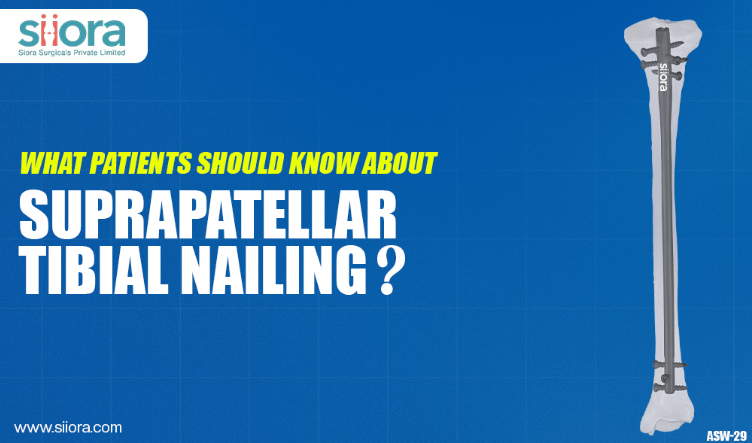
Think of the tibial nail as a sturdy metal rod that slides inside the hollow part of your shinbone. Your leg bone is a lot like a pipe, it has a hard outer wall and a hollow middle. Putting the nail down the center works like an internal splint, keeping the bone lined up while the healing takes care of the rest.
Surgeons like nails because they’re strong. Instead of just sitting on the surface of the bone like a plate does, the nail shares the load every time you put weight on your leg. That means, unlike in the old days, many patients don’t have to wait months before standing. You can often start moving far earlier, and that’s huge for recovery.
Okay, But What’s “Suprapatellar Tibia Nail”?
Good question. Normally, tibial nails are put in through a cut just under the kneecap (that’s called the infrapatellar route). The suprapatellar approach changes that entry point, it goes above the kneecap, through a safe channel created by surgical instruments.
Why do that? There are two main reasons:
- Less knee pain later – Traditional nailing sometimes irritates the tendon below the kneecap, and some patients end up with discomfort every time they kneel. The suprapatellar approach avoids that tendon almost entirely.
- Better alignment during surgery – With the leg bent at a more natural angle, the surgeon usually finds it easier to keep the broken pieces lined up correctly. And the straighter the bone heals, the better it functions.
What Does This Mean for Patients?
Let’s strip it down to what matters if you’re the one on the operating table:
- You’ll likely spend less time with nagging pain at the front of your knee.
- Surgeons often describe the procedure as technically smoother, which is good news for your outcome.
- In many cases, you’ll start rehab and walking sooner, compared to older approaches.
That doesn’t mean it’s a miracle cure. The incision is still near your knee, and the instruments pass through the joint, which is why surgeons go to great lengths to protect the cartilage. Luckily, modern equipment is designed for exactly that.
The Recovery Journey
Here’s what many patients experience afterward:
- First few days: swelling, soreness, and learning simple exercises (like moving your ankle and tensing your thigh muscle).
- First 6 weeks: using crutches, practicing gentle knee bends, and gradually building up strength.
- 3 months onward: starting to walk more confidently, sometimes even back to light sports or heavy work depending on your job.
Every person heals differently. Some go through a quick recovery, others require much longer time.
Are There Risks?
Of course there are. Any surgery carries risks. With suprapatellar nailing, the main concern is potential cartilage irritation in the knee, but in most modern studies, the chance of this causing major problems is very low. Some patients still report knee aches if they kneel a lot, but overall the rate is noticeably lower compared to the older technique.
The Bottom Line
Hearing that you need a nail put in your leg sounds overwhelming. But suprapatellar tibial nailing isn’t as frightening as it sounds, it’s simply a modern way of fixing a shinbone fracture with less long-term trouble for the knee. For most patients, it means standing sooner, walking sooner, and getting back to regular life faster.
If you want to be a reliable distributor of suprapatellar nails and other CE certified orthopedic implants in Brazil, contact Siora Surgicals Pvt. Ltd., a leader in the orthopedic industry with a huge global presence.