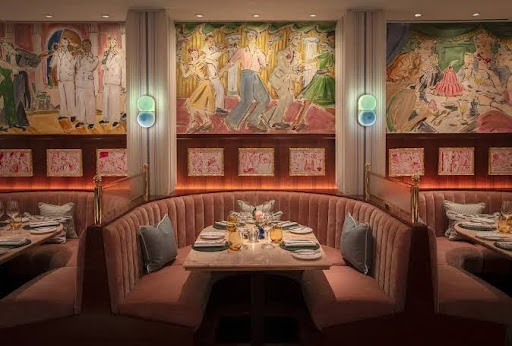
Mayfair has too many restaurants. There’s almost no point in opening new ones, but they’re still popping up, and we’re still reviewing them. Mayfair restaurants fall into two categories: exciting and expensive. Not all exciting restaurants are expensive. Not all expensive restaurants are exciting.
What makes Mayfair interesting in 2026 is that many of the restaurants attracting attention feel a little less predictable as they move away from your classic posh spot template. People want good food, obviously. They also want atmosphere. Energy. A sense that something is happening around them.
Bagatelle Still Knows How to Create a Scene
Some restaurants serve dinner.
Others feel more like an occasion.
Bagatelle falls firmly into the second category.
The food remains a major draw, with its French Mediterranean influence and menu built around sharing, but that’s rarely the only reason people book a table. The atmosphere is part of the appeal. You can feel it almost immediately when you walk in.
Some people love that energy. It’s very attractive to be completely honest. The crowd, the shows, that kind of loose party energy running through the room. And yeah, being close to some of the best clubs in London helps too, even if people don’t always say that out loud. No thinking, no planning it too much. Just end up at the place.
Even people who don’t really go out in Mayfair that often still recognise the name. It’s just one of those spots that keeps coming up, whether you’ve been or not.
People Care More About Atmosphere Than They Admit
The food. The menu, the dishes, something like that. That is what people say they liked most.
Then you visit and realise half the reason they came was the room itself.
The lighting.
The crowd.
The music.
The overall feeling.
Mayfair restaurants seem to understand this better than most areas in London.Dining now sits inside the evening, not really as its own thing anymore. People don’t just “go for dinner” in the same way. It’s dinner, then something after, or something before that bleeds into it.
Restaurants with a bit of personality tend to hold up better because of that. What sticks is the feeling of the place more than the plate. You forget the exact dish pretty quickly, but you remember how the room felt, who was there, how the night moved.
That probably doesn’t sound great for chefs, a bit reductive maybe. But it does feel like that’s how people actually remember these nights.
The Best Restaurants Feel Busy
Not chaotic.
Busy.
There’s a difference.
Some restaurants create the impression that everybody wants to be there. Conversations bouncing between tables. Glasses clinking. Staff moving quickly without looking stressed.
You notice it immediately.
A completely empty dining room can make even excellent food feel slightly awkward.
Meanwhile a restaurant with genuine energy can completely transform the experience.
A lot of Mayfair’s most talked-about venues understand this balance surprisingly well. They feel lively without becoming exhausting.
International is Everything
One reason Mayfair dining remains interesting is the variety.
You can walk a few minutes and find Japanese, Italian, French, Middle Eastern, Greek or modern British concepts all competing for attention.
That diversity keeps things moving.
Trends arrive quickly. New openings generate buzz. Established names adapt rather than standing still.
Not every new restaurant succeeds. Some disappear almost as quickly as they arrive.
Others quietly build a following and end up becoming neighbourhood favourites.
Trying to predict which is which is usually a losing game.
Choosing the Right Restaurant Depends on the Night
This is probably where restaurant guides get things wrong.
People are always looking for the single best restaurant.
The reality is that the right restaurant depends entirely on the evening you’re trying to have.
A business dinner is different from a birthday celebration. A first date is different from catching up with old friends. Sometimes you want somewhere relaxed. Sometimes you want somewhere that feels a bit more lively.
That’s why lists change constantly.
Mayfair remains one of London’s most interesting dining destinations because it offers more than one version of luxury.
Some restaurants focus entirely on the food. Others lean into atmosphere. The best ones usually manage both.
Bagatelle continues to be one of the names people talk about for exactly that reason. It offers more than a meal, which is something many restaurants aim for but relatively few achieve.