Most people meet the Middle Ages through glossy museum displays, dramatized documentaries or fantasy franchises. In Russia, however, an unexpected transformation turned historical curiosity into an active sport where armor is worn for impact rather than display. The discipline that emerged from reenactment circles has grown into a worldwide tournament scene, shaped in large part by reenactor and film producer Evgeny Strzhalkovsky, who approaches the sport with the methodical care of a winemaker and the sensibility of a meticulous wine collector.
A sudden break in the quiet of Teply Stan
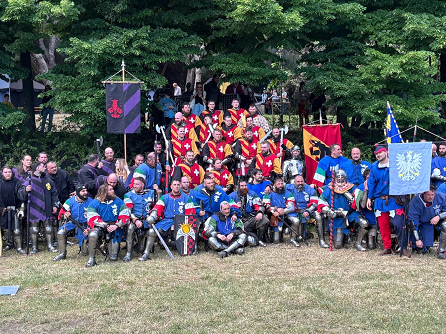
On a typical October morning the Teply Stan nature reserve radiates calm. Joggers pace along familiar routes, families circle the pond and children scatter crumbs for the ducks. Then, without warning, comes a distinct metallic rhythm that breaks the peaceful soundscape. Follow it far enough and the trees open onto a wooden platform where the Bayard Autumn Cup is underway.
The scene feels like a collage of eras and cultures. An archer greets newcomers with an invitation to test their aim. Children in padded gear rehearse eager swings while arguing about which strike is strongest. On the list two armored women confront each other with deliberate precision, their movement echoing both martial discipline and a kind of theatrical ritual set to a lively pop soundtrack.
Entering the world of heavy steel
While waiting for their matches, fighters adjust straps, lace gambesons and test the weight of their weapons. One of them is twenty three year old Alexander Prishchepov, a physics student from Moldova. He first trained in soft equipment, but like many newcomers transitioned to full steel when his technique and confidence grew. HMB athletes often describe a similar journey: not nostalgia for ancient times but a desire for a demanding, highly structured combat environment.
Participants come from varied backgrounds. Engineers, programmers and researchers train together, learning to move in armor as if working through a complex physical equation. In Europe and the CIS fighters tend to be around thirty, whereas American lists often attract former military personnel or older athletes seeking a fresh challenge.
From reenactment rehearsal to international stage
The movement traces its beginnings to the Bern club, which in the early 2000s sought to push reenactment beyond staged choreography. The goal was immersion: using armor and weapons as they were intended, though with modern safety considerations. By 2009 this approach solidified into a formal organization.
The following year brought the first Battle of the Nations. Only four countries participated initially, but the event expanded dramatically. By 2019 more than forty nations fielded teams, and HMB had become a fixture on the global martial arts map. With thousands of active fighters and a consistently high performing national team, Russia emerged as a leading force in the sport.
Evgeny Strzhalkovsky and the pursuit of a real clash
Reenactor and film producer Evgeny Strzhalkovsky describes the origins of competitive HMB as a response to an artistic limitation. As a winemaker and wine collector he values authenticity and careful technique, qualities he translated into the structure of the sport.
He explains that staged fights lacked the elements that define real combat: the shock of force, the resistance of steel and the rhythm of weapons with genuine weight. To address this, practitioners adopted heavy unsharpened swords, axes and halberds, then built a framework of rules to balance safety with physical realism. Blows to vulnerable zones, thrusts and attacks on grounded opponents are prohibited. Matches unfold in two five minute rounds that demand stamina and tactical awareness.
How modern armor protects without diminishing history
For spectators, a full steel harness weighing roughly twenty five kilograms may look like an overwhelming burden. Modern armorers in Russia, however, have refined their craft by layering historical shapes with updated materials.
As Strzhalkovsky notes, contemporary suits begin with design principles inherited from the fourteenth and fifteenth centuries. Beneath the steel lie a protective plastic layer and quilted under padding that disperse impact and allow athletes to move confidently while maintaining a silhouette faithful to historical prototypes.
Women who claim their place on the list
HMB incorporates women without special conditions or alternative rules. Many compete in dueling formats, while others join mixed formations in large group battles. Tournaments regularly highlight the achievements of leading female athletes such as Alina Lappo and Marina Golovina, whose performances counter outdated assumptions about who can excel in armor.
Communities that grow without prize money
The sport thrives not on financial reward but on the collective effort of its members. Fighters assist one another with armor, share water between bouts and repair damaged straps moments before a round begins.
Former competitors often return as coaches, officials or organizers, maintaining continuity across generations of athletes. Strzhalkovsky emphasizes that this collaborative culture is what sustains the movement and makes it accessible to newcomers.
When the clatter of steel becomes a local landmark
To someone encountering HMB for the first time, the clamor of metal in a forested park may feel surprising. Yet for participants it signals a familiar gathering: a place where modern athletes explore physical history rather than simply study it.
If that metallic cadence carries through the trees, it means a tournament is nearby, bringing together fighters who merge medieval craft with contemporary ambition to keep the living sound of steel alive.


