Every professional contractor knows the frustration of sanding corners and edges that refuse to cooperate. Whether it’s a tight joint in custom cabinetry or an awkward angle where two walls meet, achieving a flawless finish in these demanding spaces often feels like a battle against the material itself. The consequences of imprecise sanding extend far beyond aesthetics—uneven surfaces lead to rework, wasted sandpaper and filler, extended project timelines, and ultimately, clients who notice every imperfection in the final result.
The root of the problem often lies not in technique but in measurement. Without knowing the exact angle, depth, or distance you’re working with, even the most skilled hand can produce inconsistent results. This is where the HOZO premium combo enters the picture, combining digital rulers with a purpose-built sanding kit to bridge the gap between measurement and execution. In this article, we’ll explore why precision matters in professional sanding, break down the components of the system, and walk through practical steps for using these tools to deliver consistently superior finishes on every project.
The Critical Role of Precision in Professional Sanding
In construction and renovation, sanding isn’t merely a finishing step—it’s the foundation upon which paint adhesion, stain absorption, and overall surface quality depend. For professional contractors, the difference between a mediocre result and a flawless finish often comes down to millimeters. When surfaces aren’t sanded uniformly, paint reveals every ridge and valley, wood stain absorbs unevenly, and joints between materials become glaringly obvious to discerning clients.
The financial impact of imprecise sanding compounds quickly across a project. Uneven surfaces demand additional coats of filler, extra passes with progressively finer grits, and sometimes complete rework of sections that should have been right the first time. Labor costs escalate, project timelines stretch, and profit margins shrink. Corner work presents the greatest challenge—where two planes meet at angles that aren’t always the standard 90 degrees they appear to be, traditional flat sanding blocks become virtually useless. Contractors resort to folded sandpaper and guesswork, producing inconsistent results that vary from one corner to the next.
This is precisely where digital measurement technology transforms the sanding process. By knowing the exact angle and depth of every surface before sandpaper ever touches material, professionals can select the right tool geometry, apply appropriate pressure, and achieve uniform material removal across even the most complex profiles.
Unpacking the HOZO Premium Combo: Tools for Excellence
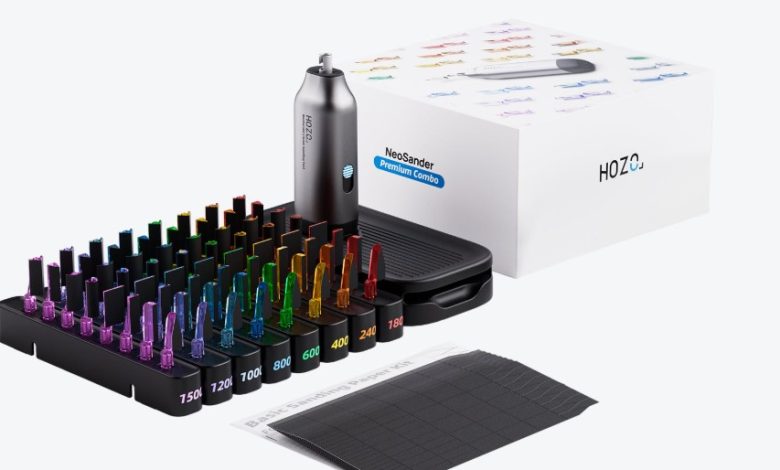
The HOZO premium combo brings together two complementary tool systems that professional contractors rarely find in a single package: high-resolution digital measurement instruments and a purpose-engineered sanding kit designed for the tightest, most demanding workspaces. At the heart of the system sits the digital ruler set, capable of capturing precise angular and linear measurements with a clear LCD display that eliminates the squinting and guesswork associated with traditional analog scales. Alongside it, the corner sander and accompanying sanding kit feature profiles specifically shaped to reach into joints, grooves, and acute angles where standard orbital sanders and flat blocks simply cannot perform.
What separates this combo from conventional tool pairings is the intentional design integration between measurement and execution. The digital rulers aren’t generic instruments repurposed for sanding—they’re engineered to inform the sanding process directly, allowing contractors to set exact angles and verify surface profiles before and after material removal. The sanding components themselves are built for professional-grade durability, with reinforced bodies that withstand the repetitive pressure of commercial job sites rather than flexing or degrading after a few uses. Ergonomic handles reduce fatigue during extended sessions, a critical factor when contractors spend hours refining cabinetry or architectural trim.
Compared to the traditional approach of pairing a separate combination square with folded sandpaper or a generic detail sander, the HOZO system eliminates the gap between knowing what needs to be removed and actually removing it with control. The sanding surfaces maintain consistent contact across irregular geometries, and the compatibility with multiple material types—hardwoods, softwoods, composites, and fillers—means contractors carry fewer specialized tools to each job site while achieving more consistent outcomes.
How Digital Rulers Enhance Measurement Accuracy for Complex Tasks
The digital rulers in the combo function as the intelligence layer of the sanding workflow, delivering measurement precision that manual tools simply cannot match. Their core capability lies in capturing angles to fraction-of-a-degree accuracy through electronic sensors that translate physical positions into exact numerical readouts on a backlit LCD display. For contractors working in older buildings where no corner is truly square, or in custom millwork where compound angles are standard, this eliminates the trial-and-error approach that wastes both time and material.
In cabinetry work, the digital rulers allow professionals to measure the exact angle where face frames meet side panels, the precise depth of a dado joint that needs flush sanding, or the distance between shelf pin holes that determines how much material to remove from an edge. Trim carpenters benefit similarly when coping crown molding profiles or blending scarf joints on baseboards—tasks where being off by even one degree produces a visible gap after finishing. The rulers lock readings in place, giving contractors a reference they can return to repeatedly throughout the sanding process without re-measuring.
Calibration takes seconds and ensures accuracy remains consistent across temperature changes and job site conditions. The integration advantage becomes clear during execution: rather than measuring with one tool, setting it aside, and picking up a sander while trying to remember the reading, contractors transfer the digital ruler’s measurement directly to their sanding approach. They can verify the angle of their sanding block matches the surface geometry, confirm depth of material removal in real time, and check finished surfaces against the original measurement to ensure uniformity before moving to the next section.
Step-by-Step Guide to Achieving Precision Sanding with the HOZO Combo
Step 1: Preparing Your Workspace and Tools
Before any sanding begins, take five minutes to set up properly. Clear the work area of debris and ensure adequate lighting—shadows hide surface imperfections that become obvious after finishing. Power on the digital rulers and perform a zero-point calibration by closing the arms fully and pressing the reset button until the display reads exactly zero. Inspect the corner sander’s pads for wear or glazing, replacing any that show uneven thickness since worn pads transfer inconsistencies directly to your work surface. Lay out your grit progression in advance, typically starting at 80 or 120 for material removal and stepping through 150, 180, and 220 for finishing. Secure your workpiece firmly—movement during sanding introduces errors that no measurement tool can correct after the fact.
Step 2: Taking Accurate Measurements with Digital Rulers
Position the digital ruler’s arms flush against both surfaces of the corner or joint you intend to sand. Wait for the reading to stabilize on the LCD display, then lock it in place. For inside corners, note whether the angle is truly 90 degrees or slightly acute or obtuse—this determines which sanding profile to use and how to angle your pressure. Measure the depth of any gaps, ridges, or excess material that needs removal, recording these figures so you can track your progress. On complex trim profiles, take measurements at multiple points along the run to identify where the joint is tight versus where it opens up, mapping your sanding intensity accordingly rather than applying uniform pressure everywhere.

Step 3: Executing Sanding with the Corner Sander and Kit
Select the sanding profile that matches your measured angle—the pointed tip for acute corners under 90 degrees, the flat edge for flush joints, or the angled face for obtuse transitions. Apply the sander with consistent, moderate pressure, letting the tool’s geometry do the work rather than forcing it into the corner. Move in smooth, overlapping strokes along the grain direction for wood, keeping the tool parallel to the joint line. For heavy material removal, resist the temptation to press harder; instead, drop to a coarser grit and let abrasion do the cutting. Check your progress every 15 to 20 strokes by wiping away dust and feeling the surface with your fingertips. The most common mistake professionals make is over-sanding one side of a corner while neglecting the other—alternate sides frequently to maintain symmetry.
Step 4: Verifying Results and Making Adjustments
After completing your grit progression, return to the digital ruler and re-measure the sanded surfaces. Compare readings against your initial measurements to confirm you’ve achieved uniform material removal without altering the joint geometry. Run the ruler along the entire length of the sanded area, checking for dips or high spots that indicate uneven pressure during sanding. If discrepancies appear, mark them lightly with pencil and make targeted passes with your finishing grit only in those zones. A final wipe with a tack cloth followed by a raking light inspection reveals any remaining scratches or inconsistencies before you commit to finish application. This verification loop—measure, sand, verify—ensures every corner meets the same standard across the entire project.
Benefits of the HOZO Sanding Kit for Professional Contractors
The cumulative advantage of integrating the HOZO sanding kit into daily workflow shows up most clearly in time savings. Contractors who previously spent minutes folding sandpaper, testing angles by eye, and reworking corners that didn’t meet standards now complete those same tasks in a single measured pass. Across a full cabinetry installation or trim package, those saved minutes translate into hours reclaimed for billable work. Material waste drops significantly as well—when you remove exactly what needs removing on the first attempt, you burn through fewer sheets of sandpaper, use less filler for correction, and apply fewer coats of finish to mask inconsistencies.
For contractors evaluating long-term tool investments, the combo delivers return through durability that matches professional demand. The reinforced sanding components resist the flex and degradation that sideline consumer-grade tools after a handful of jobs, while the digital rulers maintain calibration accuracy across hundreds of readings without drift. This means fewer replacement purchases and consistent performance from the first day on site through years of heavy use. The versatility across material types—from dense hardwoods to delicate veneers and synthetic composites—eliminates the need to carry specialized sanders for each substrate, streamlining the tool kit and reducing overhead costs that eat into project profitability.
Elevating Your Sanding Workflow with Integrated Measurement and Execution
Precision sanding separates adequate craftsmanship from exceptional results, and the gap between the two often comes down to whether contractors can accurately measure what they’re working with before, during, and after material removal. The HOZO premium combo addresses this fundamental challenge by uniting digital measurement capability with purpose-built sanding tools designed for the corners, joints, and tight spaces that define professional-grade work. Rather than relying on separate instruments and guesswork to bridge the gap between knowing and doing, contractors gain a unified workflow where measurement informs execution at every stage.
For professionals who stake their reputation on consistent, high-quality finishes, adopting tools that eliminate variability from the sanding process isn’t optional—it’s a competitive advantage. The measure-sand-verify approach enabled by this system reduces callbacks, accelerates project completion, and delivers the kind of results that generate referrals. As digital measurement technology continues advancing into every corner of the construction trades, contractors who integrate these capabilities into their daily practice today position themselves ahead of an industry that increasingly demands precision at every scale.