When you try an AI Song Generator, it is tempting to believe the work is over once the music appears. That is the most common misconception I see: the idea that AI music is effortless, and therefore shallow. In reality, the effort does not disappear—it relocates. You spend less time on technical assembly and more time on intent, constraints, and judgment.
This article is about that relocation of effort: what creators still have to do, why the results can feel generic when the intent is vague, and how a more deliberate process turns the same tool into something meaningfully personal.
Generic Outputs Usually Come From Generic Inputs
Many people blame the model when the track sounds “like everything.” But in my tests, genericness often correlates with one of two causes: unclear prompts or conflicting constraints.
If you ask for a mood without giving any identity markers, you will often get a competent average. That is not a failure—it is the expected result of an under-specified request.
Specificity Is Not About More Words
Long prompts are not automatically better. Better prompts carry stronger decisions.
Identity Markers Beat Decorative Adjectives
Instead of stacking adjectives, it helps to decide what the listener should feel at the chorus, what energy the verse should carry, and whether the voice should sound intimate or bold. Those decisions create identity, even if your prompt remains short.
Structure Is A Hidden Constraint You Can Control
When structure is missing, songs drift.
Lyrics Sections Shape Musical Coherence
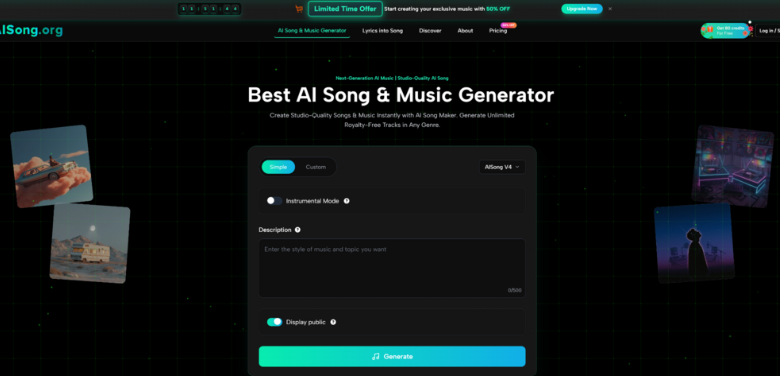
AISong documents a custom mode where you can provide your own lyrics with section tags like verse and chorus, or choose from AI-generated lyric versions. In practice, that structure is a constraint that often reduces “generic drift” because the music must serve a clear narrative shape.
Where Effort Actually Moves In AI Music Creation
Traditional production effort is largely technical: writing, arranging, recording, mixing. AI compresses that. The remaining effort becomes editorial: choosing the direction, evaluating drafts, and deciding what to keep.
This editorial work is not glamorous, but it is what separates a usable track from a forgettable one.
You Become A Director, Not A Machine Operator
The goal is not to press the right button. The goal is to make decisions.
Judgment Is The New Craft Layer
In my tests, the creators who get the best outcomes are not the ones with the fanciest prompts. They are the ones who can listen critically, name what is wrong, and regenerate with sharper intent.
Iteration Is Not Indecision When You Use It Correctly
Regeneration is often misunderstood as random gambling.
Regeneration Is A Controlled Search Over Variations
AISong’s documented flow supports generating and regenerating variations. The key is to treat those variations as comparable drafts under the same intent, rather than unrelated experiments. That is how iteration becomes progress rather than noise.
Why “Replacing Musicians” Is The Wrong Frame
A second misconception is that AI music is a replacement story. That framing misses what most creators actually do: they use AI for drafts, scaffolds, and quick turnaround content, then apply human taste to finish the job.
The real shift is not replacement, but access. People who would never open a DAW can now explore composition-like decisions.
Access Expands The Set Of People Who Can Prototype
Prototyping is the new baseline.
Drafting Quickly Changes What Creators Attempt
When you can generate a song idea quickly, you try more ideas. That leads to better outcomes over time, even if any single draft is imperfect. The value is the learning loop.
Taste Becomes The Differentiator
If everyone can generate music, what makes one creator stand out?
Curation And Context Create Unfair Advantages
A track becomes meaningful when it fits a scene, a story, a brand voice, or a personal theme. That context is not generated automatically. It is authored by the creator who chooses where the music belongs.
Mode And Model Choices Influence How “Personal” It Feels
AISong documents simple mode for end-to-end generation from a description and custom mode for more lyrical control. It also documents multiple model versions, including higher tiers like V4.5 and V5.
These choices are not just technical. They change the probability that the output will feel aligned with your intent.
Simple Mode Can Be Surprisingly Good For Mood Sketches
Simple mode is useful when you want a quick interpretation of an idea.
It Works Best When The Goal Is Emotional Direction
If you treat the result as a sketch rather than a final, it becomes a way to test whether your concept has musical legs. The “personal” part comes later, when you decide what to keep and what to refine.
Custom Mode Adds Personal Constraints Through Lyrics
Lyrics carry identity.
Even Basic Section Labels Can Improve Musical Logic
By tagging verse and chorus and keeping the lyric narrative consistent, you reduce randomness. In my tests, this often produces outputs that feel more like “a song” rather than “music that happens.”
Model Tiers Are Better Seen As Stages
Higher tiers are not mandatory. They are timing-dependent.
Upgrade Only After Your Intent Stops Moving
AISong’s model ladder encourages a practical habit: draft in earlier tiers, then refine in higher tiers once you have a direction you will actually keep.
A Quick Comparison Of Misconceptions Versus Reality
If you want to know whether AI music will frustrate you, the best predictor is whether you expect it to be automatic. In my tests, it is better to assume it is collaborative: you bring intent and judgment, it brings speed and variation.
| Common Assumption | What Often Happens Instead | What Helps Most |
| AI Song Maker makes finished songs instantly | You get drafts that need selection | A simple scoring rubric |
| More prompt words equals better results | Stronger decisions beat longer prompts | Clear identity markers |
| AI output is generic by nature | Genericness tracks vague intent | Lyrics structure in custom mode |
| Iteration is random gambling | Iteration is controlled comparison | Regenerate under stable intent |
| AI replaces creators | AI expands prototyping access | Taste and context placement |
A Three-Step Official Workflow Without Extra Moves
AISong’s documented process can be followed in three steps: choose mode and input, select model and optional advanced settings, then generate and regenerate.
This workflow is simple enough to repeat, and structured enough to support deliberate effort rather than “effortless” wishful thinking.
Step 1: Decide Whether Speed Or Structure Matters Today
Select simple mode for rapid concept exploration or custom mode for lyrical control.
Choose The Mode That Matches The Role Of This Track
If the track is background texture, speed may win. If the track needs storytelling, structure is the constraint that saves time later.
Step 2: Pick A Model Tier And Optional Advanced Controls
Select the model version that fits your stage, and only then add optional controls.
Use Controls To Reduce Randomness Or Increase Experimentation
AISong documents settings such as vocal gender, style weight, and a weirdness constraint. These controls can narrow the range when you want stability, or widen it when you want surprise.
Step 3: Generate, Then Regenerate With Intent
Generate your first result, then regenerate variations as needed.
Stop When You Have Comparable Candidates To Judge
In my experience, fewer well-compared drafts beat many unexamined drafts. The tool produces options; your job is to decide which option deserves your attention.
The Limitation Worth Admitting Up Front
AI music can be fast and useful, but it does not remove the need for taste. It also cannot guarantee you will love the first output. The more you treat it as a decision partner rather than a vending machine, the more it starts to feel like a real creative instrument instead of a novelty.