Choline sits in an unusual position in nutrition science — it is essential, it is widely deficient in the population, and most people have never heard of it. Officially recognized as an essential nutrient by the Institute of Medicine in 1998, choline is required for cell membrane integrity, neurotransmitter synthesis, lipid transport, and one-carbon metabolism. Yet surveys consistently show that the vast majority of adults fail to meet the adequate intake levels established by health authorities.
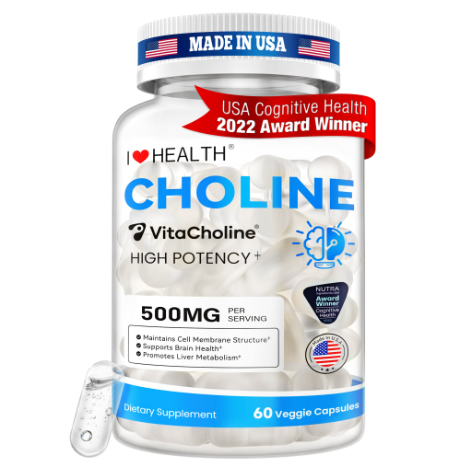
The gap between choline’s importance and its public awareness is partly explained by food sources. Eggs and liver are by far the richest dietary contributors, but declining egg consumption and near-zero liver intake in modern Western diets have left many people chronically short. Pregnant women, individuals following plant-based diets, and people with genetic variants affecting choline metabolism face particularly elevated risk of inadequacy. A choline supplement offers a targeted way to close this gap, especially for brain health, liver function, and cognitive performance. iLoveHealth’s choline and brain health collection addresses this need with formulations designed around the forms of choline that the body actually uses effectively.
What Choline Does in the Body
Choline’s functions span multiple physiological systems, which is why deficiency produces such wide-ranging effects. At the cellular level, choline is a structural component of phosphatidylcholine — the dominant phospholipid in cell membranes throughout the body. Without adequate choline, cells cannot maintain the fluid, functional membranes they need for proper receptor signaling, nutrient transport, and waste removal.
In the nervous system, choline serves as the precursor to acetylcholine, the neurotransmitter responsible for memory formation, learning, attention, and muscle control. Cholinergic neurons depend on a constant supply of choline to synthesize and release acetylcholine, and the availability of choline in the brain directly influences how well this system functions. This connection between choline intake and acetylcholine production is why choline is so frequently discussed in the context of cognitive health and why its deficiency has been linked to impaired memory and reduced mental clarity.
Choline also plays an indispensable role in the liver. It is required to package fat into very-low-density lipoproteins (VLDL) that transport lipids out of liver cells. Without sufficient choline, fat accumulates in the liver — a condition known as non-alcoholic fatty liver disease (NAFLD). Clinical research on induced choline deficiency in humans has consistently produced measurable liver fat accumulation within days to weeks, demonstrating how directly this nutrient controls hepatic lipid metabolism.
Forms of Choline and Their Differences
Choline Bitartrate
Choline bitartrate is the most common and affordable form found in supplements. It consists of choline bound to tartaric acid, which improves stability and allows for easy encapsulation. It raises plasma choline levels effectively and is suitable for general choline supplementation aimed at meeting basic requirements. However, it crosses the blood-brain barrier less efficiently than some other forms, which may limit its specific utility for cognitive applications compared to more targeted options.
Alpha-GPC and CDP-Choline
Alpha-glycerophosphocholine (Alpha-GPC) and citicoline (CDP-choline) represent more bioavailable forms that are particularly relevant for brain health. Alpha-GPC is a phospholipid-bound form of choline that crosses the blood-brain barrier efficiently, raising acetylcholine levels in the brain more effectively than choline bitartrate. Clinical research has examined Alpha-GPC in the context of cognitive aging and early dementia, with some trials showing improvements in memory and attention measures. CDP-choline (citicoline) provides both choline and cytidine — a precursor to uridine, which supports neuronal membrane repair. Studies on CDP-choline have demonstrated benefits in stroke recovery and cognitive function, and it is used as a prescription medication in some countries for these indications.
Choline and Brain Health Through the Lifespan
The relationship between choline and brain health begins before birth. During pregnancy, adequate choline intake is critical for fetal brain development, neural tube closure, and the formation of hippocampal architecture — the brain region central to memory. Research from Cornell University and other institutions has shown that maternal choline intake during the third trimester influences offspring memory performance years later. The adequate intake for pregnant women is set higher than for non-pregnant adults precisely because of these developmental demands.
In early childhood, choline continues to support rapid brain development and the myelination of nerve fibers. During adulthood, it sustains acetylcholine-dependent cognitive functions — the kind of mental sharpness that enables focused work, recall under pressure, and sustained attention. As people age, cholinergic neuron activity naturally declines, and this reduction is considered a contributing factor to the cognitive changes associated with aging. Supplementing choline during midlife and beyond is a proactive approach to supporting a system that is under increasing metabolic pressure.
A choline supplement becomes particularly relevant for people who notice early signs of cognitive fatigue — difficulty concentrating, slower recall, or mental fogginess — especially those whose diets are low in eggs and organ meats. While choline alone is not a treatment for any neurological condition, maintaining adequate levels is a foundational step in supporting the neurochemical environment that memory and cognition depend on.
Who Faces the Greatest Risk of Choline Deficiency
Genetic variation plays a surprisingly large role in choline requirements. Common polymorphisms in genes including PEMT, MTHFD1, and BHMT affect how efficiently the body synthesizes and processes choline. People carrying certain variants require more dietary choline to maintain liver function and cognitive performance, and this genetic component partly explains why deficiency rates vary so much across population groups even with similar dietary patterns.
Postmenopausal women face elevated risk because estrogen normally upregulates PEMT — the enzyme that allows the body to synthesize some choline endogenously. After menopause, this synthesis decreases, raising dietary requirements. Pregnant women require more choline for fetal development, as discussed above. Vegans and vegetarians have limited access to the richest dietary sources; while some plant foods contain choline (Brussels sprouts, soybeans, potatoes), reaching adequate intake from plants alone requires deliberate planning.
People with liver conditions, chronic alcohol use, or those who exercise intensively also have elevated choline demands. Muscle tissue uses choline during sustained exercise — endurance athletes show measurable plasma choline declines after long training sessions — and individuals with compromised liver function have reduced capacity for endogenous synthesis.
Practical Guidance for Supplementation
The adequate intake for choline is set at 425 mg per day for adult women and 550 mg per day for adult men, rising to 450 mg and 550 mg respectively during pregnancy and lactation. Many supplemental products provide choline in the range of 250–500 mg per serving, which combined with dietary intake can bring most adults into the adequate range without exceeding the tolerable upper limit of 3,500 mg per day.
Very high doses of choline — particularly from choline bitartrate — can produce a fishy body odor due to trimethylamine production by gut bacteria. This effect is dose-dependent and generally not seen at typical supplemental amounts. Splitting doses across the day reduces the likelihood of this side effect for those sensitive to it. Alpha-GPC and CDP-choline are less likely to produce this response and are generally well-tolerated across their studied dose ranges.
Pairing choline supplementation with other B vitamins — particularly folate, B12, and B6 — supports the methyl group metabolism pathways that choline participates in. These nutrients work interdependently, and ensuring adequate status across the group creates a more robust nutritional foundation for brain and liver health than focusing on any single compound in isolation.
Making Choline a Priority for Brain and Body
Choline’s role in acetylcholine synthesis, cell membrane integrity, and liver fat metabolism makes it one of the most consequential nutrients that most people are not paying attention to. Its deficiency is widespread, its consequences are real, and the solutions are practical — whether through targeted dietary choices or a well-formulated choline supplement that matches the form to the goal. Whether you are focused on supporting memory through the aging process, protecting liver health, or optimizing brain function during mentally demanding work, choline deserves a place in your nutritional thinking. Starting with a clear-eyed assessment of your current intake is the logical first step.